 7426872766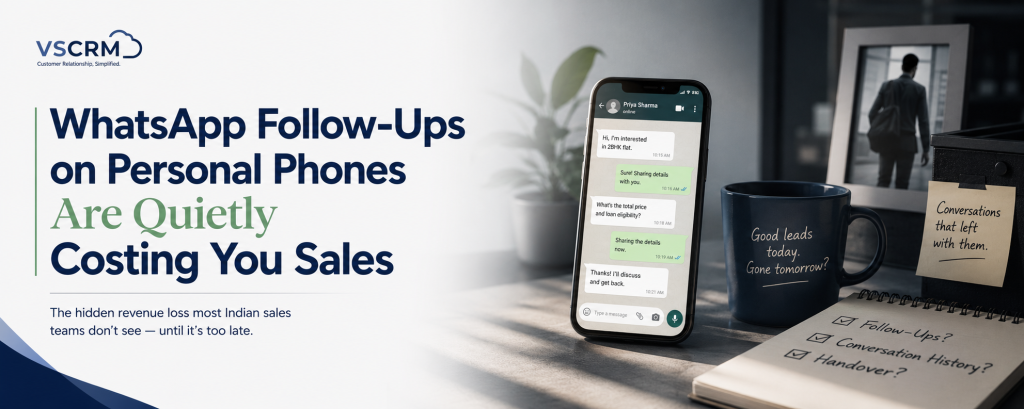
If you run a sales team in India, chances are most of your real conversations aren’t happening inside your CRM. They’re happening on WhatsApp—on someone’s personal phone, in a chat thread that only one salesperson can see.
It works for a while. A lead comes in, someone messages them, a conversation starts, maybe a deal closes. Nothing seems broken.
But this is one of those problems that doesn’t become visible until it becomes expensive—usually the day a top performer resigns and takes months of warm customer conversations with them because everything was stored on a personal phone.
The Setup That Feels Fine Until It Isn’t
Most small and mid-sized businesses in India didn’t intentionally build their sales process this way. It simply happened over time.
A lead arrives from Facebook Ads, Google Ads, a property portal, or a website form. A salesperson calls the lead and says, “I’ll send you the details on WhatsApp.” From that moment onward, the entire customer relationship moves into a private chat.
This is especially common in Real Estate CRM, Insurance CRM, Loan CRM, and Education CRM, where buying decisions take weeks or even months.
Customers prefer WhatsApp because it’s fast, familiar, and convenient.
The problem isn’t WhatsApp.
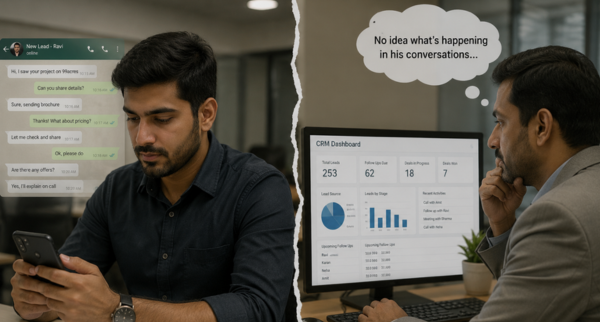
The problem is that the conversation lives on a personal device instead of inside your Lead Management Software.
What Actually Goes Wrong
1. Customer conversations disappear when employees leave
A salesperson has been following up with 40 qualified leads for months.
They resign.
Every promise, objection, document, quotation, and follow-up conversation disappears with them because everything lives inside their personal WhatsApp account.
The next salesperson starts from scratch.
Many of those leads never respond again.
2. Managers lose visibility
Without a connected CRM Software, managers can’t answer simple questions like:
- Which leads were contacted today?
- Which prospects are waiting for a reply?
- Which salesperson is actually following up consistently?
Instead, managers depend on manual CRM updates or daily team meetings.
Neither scales as your sales team grows.
3. Follow-ups get forgotten
Personal WhatsApp chats don’t remind anyone when a prospect has gone silent.
Important conversations slowly move down the chat list until someone remembers them days—or even weeks—later.
By then, many customers have already chosen another business.
4. Handover becomes difficult
When leads need reassignment, managers don’t have access to the complete conversation history.
The new salesperson only receives basic CRM notes while the actual relationship remains locked inside another person’s phone.
That creates delays, repeated questions, and frustrated customers.
5. There is no reliable conversation history
If a customer disputes what was promised…
If management needs to review communication…
Or if the company requires an audit…
There is often no centralized record available.
Only screenshots—if they still exist.
These problems rarely create one massive failure.
Instead, they quietly reduce conversion rates every single month.
Missed follow-ups.
Cold leads.
Lost context.
Poor handovers.
Over time, these small losses become significant revenue.

Why “Just Update the CRM” Doesn’t Work
Most companies respond by introducing stricter rules.
“Update the CRM after every WhatsApp conversation.”
“Maintain a follow-up spreadsheet.”
“Submit daily reports.”
The intention is good.
The reality is different.
When salespeople are handling multiple conversations simultaneously, updating two separate systems becomes extra work.
Eventually, updates become incomplete.
Not because people are lazy.
Because the process itself is inefficient.
The best-performing teams remove duplicate work instead of asking people to work harder.
What a Better Setup Looks Like
The solution isn’t asking customers to stop using WhatsApp.
That would only reduce response rates.
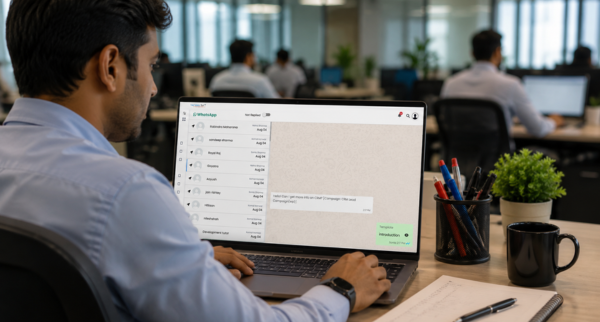
The smarter approach is connecting WhatsApp Business API directly with your CRM Platform.
Now every conversation automatically becomes part of the customer’s timeline.
Messages.
Media files.
Brochures.
Payment reminders.
Templates.
Bulk campaigns.
Everything is automatically attached to the lead.
If a salesperson leaves, another team member simply opens the customer record and continues the conversation.
Nothing is lost.
Managers can instantly see:
- Complete conversation history
- Pending follow-ups
- Response times
- Team activity
- Lead status
- Call history
No manual updates.
No guesswork.
No asking salespeople for screenshots.
How VSCRM Solves This
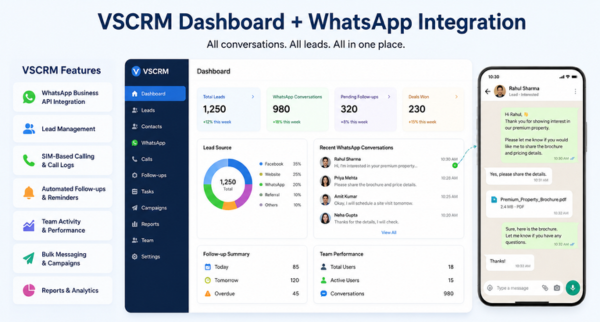
VSCRM combines WhatsApp CRM, Lead Management, SIM-Based Calling, and Sales Automation into one platform.
Instead of switching between multiple apps, your sales team manages everything from one dashboard.
With VSCRM, your team can:
- Send and receive WhatsApp Business API messages directly inside the CRM.
- Automatically save every conversation against the customer’s profile.
- Schedule automated follow-up reminders.
- Get overdue lead alerts before opportunities go cold.
- Run bulk WhatsApp campaigns.
- Track call history alongside WhatsApp conversations.
- Monitor complete team activity from a single dashboard.
Customers continue chatting on WhatsApp exactly as they always have.
The difference is that your business finally owns the customer relationship—not an individual employee’s phone.
Ask Yourself These Three Questions
You don’t need a detailed audit to know if this problem already exists.
Ask yourself:
- If your best salesperson resigned tomorrow, could another employee continue every active customer conversation immediately?
- Can you see exactly which leads haven’t received a follow-up during the last five days?
- If a customer questioned something your team promised, could you instantly open the complete conversation history?
If your answer is No to even one of these questions, your sales process is already leaking opportunities.
The losses simply aren’t visible yet.
The Real Fix Is Structural, Not Behavioral
Salespeople don’t lose deals because they don’t care.
They lose deals because the system makes it easy for important conversations to disappear, follow-ups to be forgotten, and customer history to become inaccessible.
A better sales process doesn’t depend on memory.
It depends on systems that automatically capture, organize, and protect every customer interaction.
When your CRM, WhatsApp Business API, calling, and follow-up automation work together, your team spends less time managing conversations—and more time closing deals.
Ready to Stop Losing Leads on Personal WhatsApp?
If your sales team still manages customer follow-ups on personal phones, now is the time to fix it before those hidden losses beco me visible.
Book a Free Demo and see how VS WhatsApp Business API helps businesses centralize WhatsApp conversations, automate lead follow-ups, and give managers complete visibility into every customer interaction.