 7426872766
Generating leads is only the beginning of a sales process.
The harder part is making sure those leads don’t disappear between the first enquiry and the final sale.
Consider a common situation.
Your business receives leads from Facebook and Instagram ads, Google, WhatsApp, your website, referrals and phone calls. Salespeople start calling them. Some prospects ask for pricing. Some want a demo. Others say, “Call me next week.”
A few days later, it becomes difficult to answer a simple question:
What happened to all those leads?
Some are being followed up. Some haven’t been contacted yet. A few are close to buying. And some have quietly gone cold because the next follow-up never happened.
A sales funnel makes that journey visible.
More importantly, sales funnel management helps you understand where prospects are dropping out, which opportunities deserve attention and what your sales team should do next.
Let’s look at how it works in practice.
What Is a Sales Funnel?
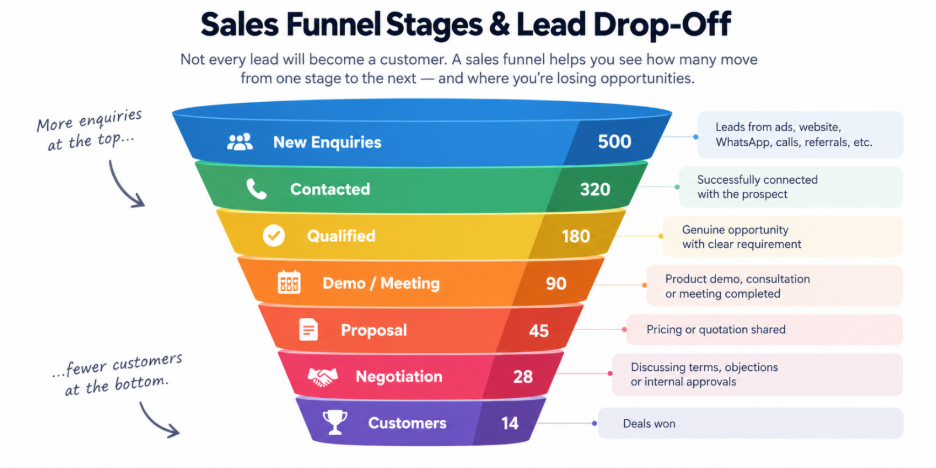
A sales funnel represents the journey a potential customer takes from initial interest to becoming a customer.
It is called a funnel because you normally start with more enquiries at the top and end with fewer customers at the bottom.
For example, a business might start with 500 enquiries. Some prospects are contacted, fewer turn out to be qualified, some reach a demo or meeting, and an even smaller number eventually buy.
The final conversion number matters, but the movement between those stages tells you much more.
If 500 enquiries eventually produce 14 customers, don’t only ask:
“Why did we get only 14 sales?”
Ask:
How many leads were actually contacted? Where was the biggest drop? Did qualified prospects receive proper follow-ups? How many reached a proposal?
Those questions are the real purpose of sales funnel management.
Sales Funnel vs Sales Pipeline: What’s the Difference?
The terms are closely related, so they’re often used interchangeably.
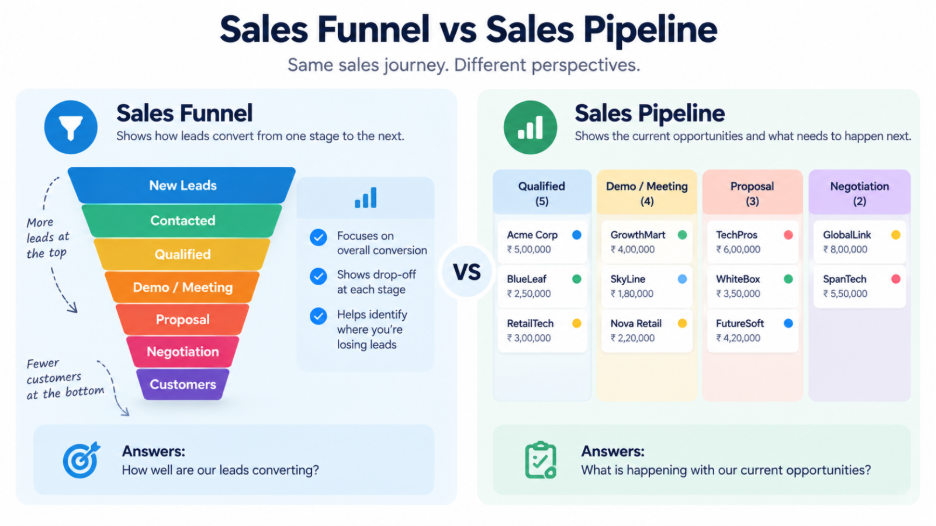
A sales funnel gives you the conversion picture—how prospects move through different stages and how many eventually become customers.
A sales pipeline focuses on the opportunities your sales team is currently working on and the actions needed to move those opportunities forward.
An easy way to remember it:
Sales funnel: How well are our leads converting?
Sales pipeline: What is happening with our active opportunities?
A sales manager generally needs visibility into both.
Why Sales Funnel Management Matters
A funnel shouldn’t exist only as a colourful chart on a dashboard.
It should help your team identify problems early enough to do something about them.
1. It Shows Where You’re Losing Opportunities
Suppose marketing generated 600 leads this month but sales are below target.
The immediate reaction might be:
“We need better leads.”
Maybe.
But the funnel could reveal something completely different.
Perhaps 150 leads were never contacted. Or plenty were qualified, but very few received the promised second follow-up.
Without stage-wise tracking, a process problem can easily be mistaken for a lead-quality problem.
As lead volume grows, a structured lead management process helps keep ownership, follow-ups and pipeline movement visible.
2. It Makes Follow-ups More Systematic
Most prospects don’t buy during the first conversation.
They say things like:
“Send me the details.”
“Call me on Monday.”
“Let me discuss this internally.”
“We may need this next month.”
None of these are closed deals.
The opportunity stays alive only if the next action happens.
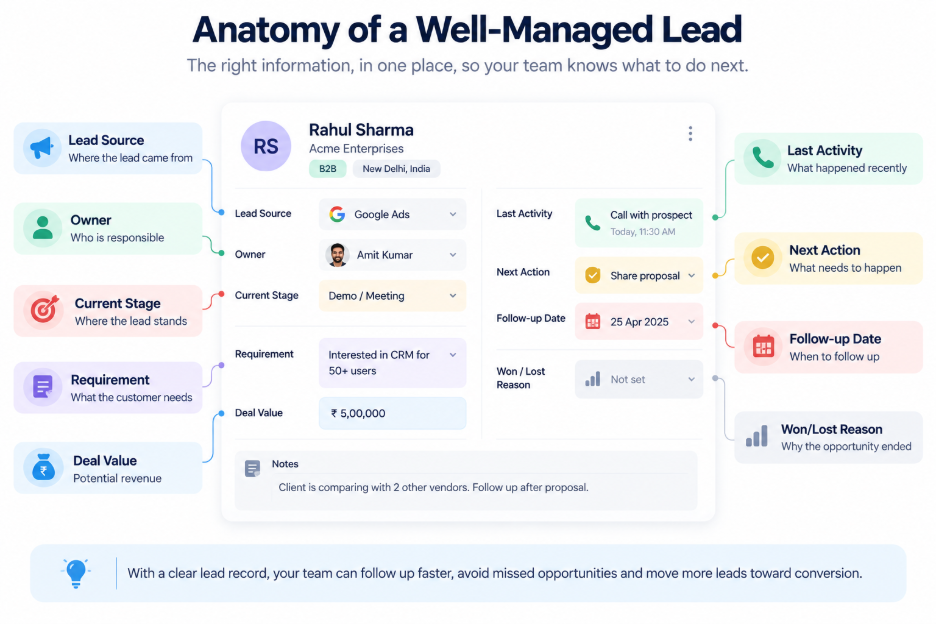
Every active lead should ideally have four things:
an owner, a current stage, a next action and a follow-up date.
That simple discipline prevents many opportunities from slipping away.
3. It Gives Managers Better Visibility
A manager shouldn’t have to ask every salesperson for a verbal update just to understand the pipeline.
“Customer is interested” doesn’t tell a manager very much.
Something like this does:
“Demo completed Tuesday”. Customers requested annual pricing. The decision maker will review it on Friday. Follow-up scheduled for Friday afternoon.”
The difference is simple: there is a clear next step.
4. It Helps You Judge Lead Sources More Accurately
More leads don’t automatically mean a better marketing channel.
Suppose Campaign A generates 300 leads and 8 customers, while Campaign B generates only 120 leads but 11 customers.
Campaign A produced more enquiries.
Campaign B produced more customers.
When lead-source data is connected with sales stages, marketing teams can look beyond cost per lead and start measuring what matters further down the funnel: qualified opportunities and actual conversions.
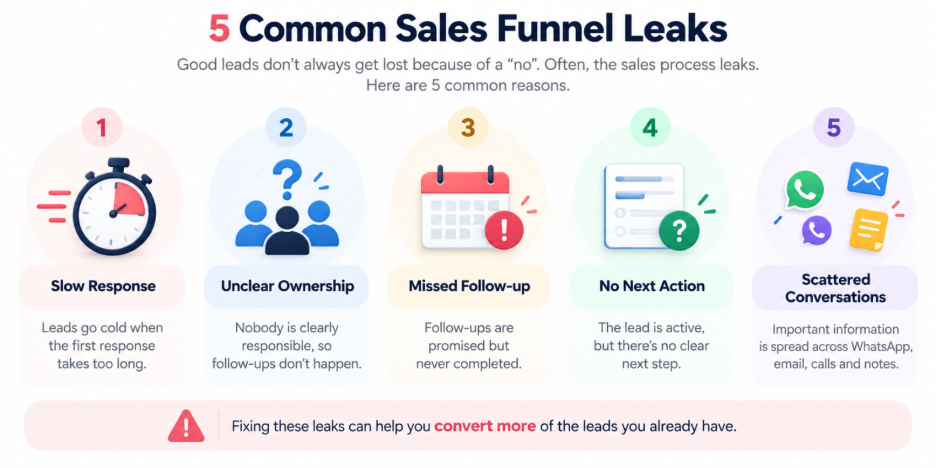
Where Do Sales Funnels Usually Leak?
You don’t need a complicated analytics model to find many funnel problems.
A few operational issues appear repeatedly: slow response to new enquiries, unclear ownership, missed follow-ups, opportunities without a clear next action and customer conversations scattered across different tools.
WhatsApp deserves particular attention because many sales conversations happen there. When those conversations are spread across individual phones, a WhatsApp CRM integration can help keep communication connected with lead ownership, status and follow-up history.
The important part is recognizing that these aren’t always lead-quality problems.
Sometimes the prospect was interesting.
The sales process simply failed to move them forward.
What Are the Main Sales Funnel Stages?
There is no single funnel that works for every company.
But most B2B sales teams can start with a structure similar to this.
1. New Lead
The enquiry has just entered your sales process.
Capture the basic information: contact details, lead source, requirement and time of enquiry.
At this stage, speed matters. The immediate goal is to make the first meaningful contact.
2. Contacted
A salesperson has successfully connected with the prospect.
A missed call shouldn’t automatically be treated as a complete contact. Recording the actual outcome gives you a much more accurate funnel.
3. Qualified
Now you need to understand whether there is a genuine opportunity.
Useful qualification information may include the prospect’s requirement, budget, timeline, current solution and decision-making process.
Keep this conversation sound natural.
Qualification should help you understand the customer—not make them feel as though they’re completing another form.
4. Demo or Meeting
For a software business, this could be a product demo.
For another industry, it might be a consultation, meeting, or site visit.
Reaching this stage usually indicates stronger buying intent.
5. Proposal
Pricing, scope, or a formal quotation has been shared.
The salesperson should know what needs to happen next instead of simply marking the proposal as “sent.”
6. Negotiation
Commercial terms, objections, competitors, or internal approvals are now being discussed.
The expected decision date becomes particularly useful at this stage.
7. Won or Lost
Every serious opportunity eventually needs an outcome.
And when a deal is lost, don’t stop selecting Lost.
Record why.
Was it priced? Timing? Budget? A competitor? A missing requirement? No response?
Over time, those reasons can reveal useful patterns across sales, marketing, and even your product strategy.
Your Sales Funnel Should Match How Your Customers Buy
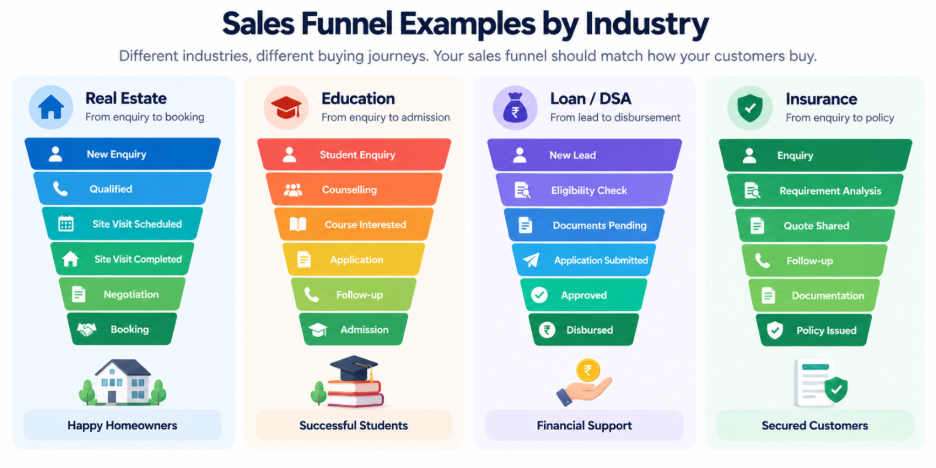
One of the easiest mistakes is copying a generic funnel from the internet and forcing the sales team to use it.
A real estate customer doesn’t buy the same way as a software customer. A loan applicant goes through different steps than a student choosing a course.
Real estate businesses, for example, often need stages such as site visits scheduled, site visits completed, negotiation, and booking. That’s why a dedicated real estate CRM workflow can look different from a generic B2B funnel.
Similarly, businesses with longer B2B sales cycles may benefit from a B2B CRM workflow that keeps qualification, multiple follow-ups, proposals, negotiations, and decision makers visible throughout the process.
Your stages should reflect how your customers actually buy.
The principle is simple:
Your CRM should fit your sales process—not the other way around.
How to Build a Sales Funnel for Your Business
Don’t start by opening your CRM and creating 20 statuses.
Start with the way your customers actually buy.
Take 10–20 recent successful deals and work backwards.
Ask:
- Where did the lead come from?
- What happened during the first conversation?
- What made the lead a genuine opportunity?
- Was a demo, meeting, consultation or site visit required?
- When was pricing discussed?
- What objections came up?
- What happened immediately before the customer decided to buy?
You’ll usually start seeing a pattern.
Turn the important milestones into stages.
Then answer two questions for every stage:
What must happen before a lead enters this stage?
What should happen next to move the lead forward?
For example, don’t move a prospect to Qualified simply because a salesperson spoke to them.
Define what qualified actually means for your business.
Maybe the customer has a genuine requirement, suitable budget and expected purchase timeline.
Clear definitions make your funnel much more reliable.
What Should You Track for Every Lead?
More CRM fields don’t automatically mean better sales data.
In fact, asking salespeople to fill dozens of fields after every conversation often creates the opposite problem: they stop updating them properly.
Track information that helps someone take action or make a decision.
A manager should be able to open an opportunity and quickly understand where it came from, who owns it, what happened last, what needs to happen next and when that action is due.
For serious opportunities, potential deal value and the final won/lost reason also become useful.
Five Sales Funnel Metrics Worth Checking Every Week
You don’t need 30 KPIs to understand whether your funnel is healthy.
Start with five.
1. New Leads
How many fresh opportunities entered the funnel?
This gives you the starting point for understanding whether there is enough opportunity at the top.
2. First Response Time
How quickly does your team respond after a new enquiry arrives?
A large lead volume means little if interested prospects are waiting too long for the first contact.
3. Overdue Follow-ups
How many promised actions have already passed their due date?
This is one of the simplest ways to spot preventable sales leakage.
4. Stage Conversion Rate
Don’t only measure leads versus final customers.
Look at movement between important stages:
Lead → Qualified → Meeting → Proposal → Customer
If conversion suddenly drops at one particular stage, you know where to investigate.
5. Lead-Source Conversion
Compare sources based on how many leads become qualified opportunities and customers—not simply how many enquiries they generate.
These five numbers can make a weekly sales review considerably more useful.
Do More Leads Always Mean More Sales?
No.
And this distinction can save businesses a lot of wasted marketing spend.
Imagine you’re already generating 1,000 leads every month, but 250 aren’t being contacted properly.
Increasing your ad budget may bring another 500 enquiries.
But if the same process continues, you’ve increased lead volume without fixing the reason opportunities are being lost.
Before spending more to fill the top of the funnel, check:
- How many fresh leads remain untouched?
- How quickly does the team respond?
- How many follow-ups are overdue?
- Which stage has the largest drop?
- How many qualified opportunities have no next action?
Sometimes you need more leads.
Sometimes you need to manage the ones you already have better.
Knowing the difference matters.
Can You Manage a Sales Funnel in Excel?
Yes—especially when you’re starting out.
For a small team with a manageable number of leads, a properly maintained spreadsheet can work.
You can track the salesperson, source, status, last activity and next follow-up without immediately investing in another tool.
The challenge begins as the sales operation grows.
Leads start arriving from multiple channels. Several salespeople work simultaneously. Follow-ups increase. Managers need reports. Customer conversations sit across different platforms.
Eventually, maintaining the spreadsheet itself becomes part of the workload.
That’s usually the point when CRM software becomes more useful—not because Excel suddenly became a bad tool, but because the sales process has become more complex than a spreadsheet was designed to manage.
If you’re still deciding whether your business has reached that point, this CRM guide for Indian businesses goes deeper into how CRM fits into everyday lead and sales management.
How CRM Software Helps Manage a Sales Funnel
A sales CRM connects your funnel stages with the activities required to move opportunities forward.
A new lead can be captured, assigned to the appropriate salesperson, contacted, scheduled for follow-up and moved through the relevant sales stages while maintaining its activity history.
That continuity is more important than simply storing customer details.
The salesperson can see what needs attention next.
The manager can see which opportunities are progressing and which have stalled.
And marketing can get a clearer picture of what happened to the leads it generated.
For example, VSCRM brings lead management, assignment, follow-up tracking and sales pipeline visibility into the same workflow. This can be particularly useful for teams receiving enquiries from multiple channels and trying to understand what happens after each lead enters the sales process.
The software, however, is only part of the equation.
A CRM won’t fix unclear sales stages, poor qualification or a team that doesn’t record outcomes.
The process still needs to make sense.
Technology simply makes a good process easier to maintain as lead volume and team size grow.
The Bottom Line
A useful sales funnel should help you answer three questions:
Where are our leads right now?
Where are we losing them?
What should happen next?
Start with a simple funnel that reflects how your customers actually buy.
Give every active opportunity a clear owner and next action. Keep your stages meaningful. Review the few metrics that reveal whether opportunities are actually moving forward.
And before assuming you need more leads, look closely at what is happening to the ones already inside your funnel.
Sometimes the biggest sales opportunity isn’t at the top of the funnel.
It’s the lead your team already has—but hasn’t moved forward yet.
If managing that process across spreadsheets, calls, WhatsApp and different lead sources is becoming difficult, explore how VSCRM handles lead management and follow-ups or see how the workflow could fit your own sales process.
Frequently Asked Questions
What is sales funnel management?
Sales funnel management is the process of tracking potential customers through different stages of their buying journey, identifying where opportunities are getting stuck and taking the right actions to move them toward conversion.
What are the typical sales funnel stages?
A common B2B sales funnel includes New Lead, Contacted, Qualified, Demo or Meeting, Proposal, Negotiation and Won/Lost. The exact stages should reflect how customers buy from your business.
What is the difference between a sales funnel and a sales pipeline?
A sales funnel focuses on how leads convert across different stages. A sales pipeline focuses more on the active opportunities and sales activities your team is currently managing.
What are the most important sales funnel metrics?
Useful metrics include new leads, first response time, contact rate, overdue follow-ups, stage-wise conversion, win rate and lead-source conversion.
Can CRM software improve sales funnel management?
A CRM can make funnel management easier by centralizing lead information, assigning ownership, scheduling follow-ups, maintaining activity history and providing pipeline visibility. A CRM works best when the underlying sales process is clearly defined.
When should a business move from Excel to CRM?
Consider moving to a CRM when leads are coming from multiple channels, several salespeople handle enquiries, follow-ups are being missed, reporting takes too much manual effort or managers struggle to get an accurate view of the sales pipeline.