 7426872766
A prospect asks for pricing, you send it, and two days later the follow-up starts.
“Any update?”
No response.
A few days later:
“Just checking if you had a chance to review.”
Still nothing.
At this point, many sales teams assume the lead has gone cold. But sometimes the problem is not a lack of interest. The follow-up itself has stopped being useful.
Most prospects do not need another reminder that you are waiting for an answer. They need a reason to continue the conversation: a clearer explanation, help with an objection, a relevant example, a practical next step, or simply better timing.
That is what a good sales follow-up strategy is supposed to do.

It should help the salesperson stay relevant without becoming repetitive, keep genuine opportunities from being forgotten, and make it easier to recognise when a lead should move out of active follow-up and into nurturing.
This guide explains how to build that process around seven purposeful touchpoints rather than seven consecutive days of chasing.
Why Sales Follow-Ups Often Stop Working
The first sales conversation is usually the easiest.
The prospect has just enquired, the problem is fresh in their mind, and the salesperson has a clear reason to make contact.
The quality often drops after that.
A prospect says:
- “Send me the pricing.”
- “Share the details on WhatsApp.”
- “Let me discuss it with my team.”
- “Call me again next week.”
The information is sent, but the next conversation becomes less specific. Instead of continuing from what the buyer actually said, the salesperson falls back on messages such as “Any update?” or “Did you check?”
These messages are not offensive. They are simply easy to ignore because they add no new context.
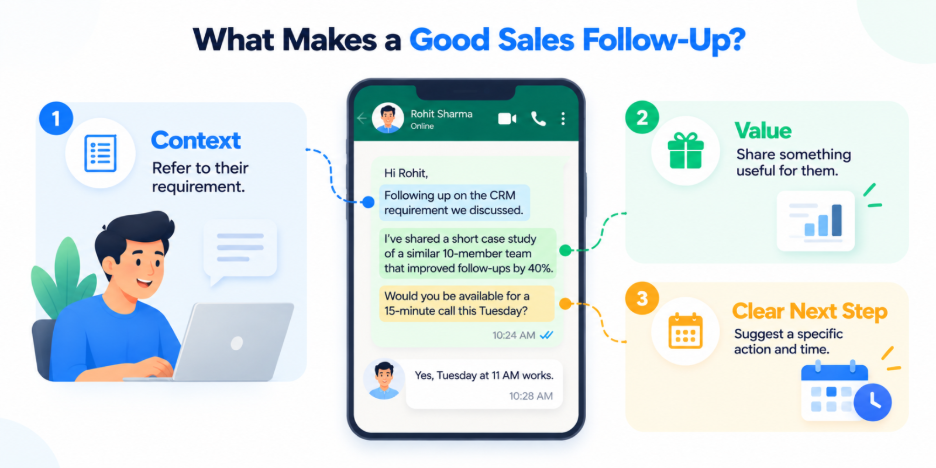
A stronger follow-up refers back to the original requirement and helps the buyer move one step closer to a decision.
For example, if a prospect says their main issue is missed Facebook leads, the follow-up should not be:
“Did you check the CRM details?”
A better message would be:
“You mentioned that Facebook enquiries are currently being assigned manually. I’ve shared the part that shows how lead assignment and follow-up reminders would work for your team.”
The second message gives the buyer something specific to consider.
That difference matters more than simply increasing the number of reminders.
Seven Touchpoints Does Not Mean Seven Consecutive Days
The phrase “7-step follow-up” is often misunderstood.
It does not mean contacting the prospect every day for a week.
A lead who asked to reconnect next month does not need seven messages over seven days. Someone who requested a proposal yesterday may need a response much sooner.
The sequence should follow the context of the opportunity.
A typical pattern might look like:
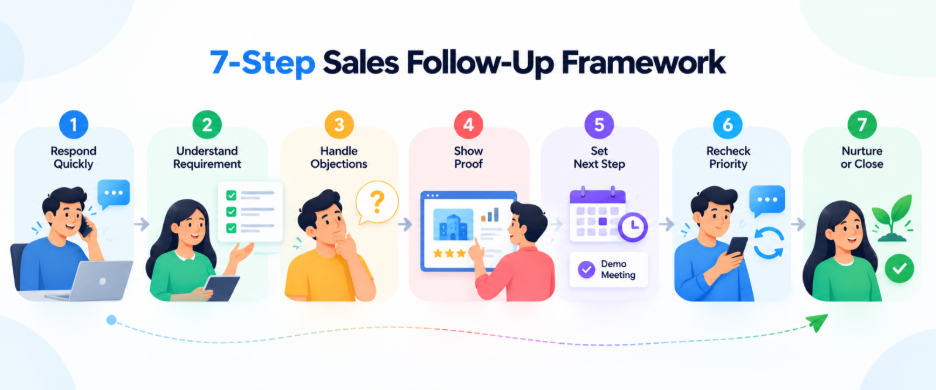
Initial response → short follow-up → useful information → objection handling → proof or example → decision check → nurture or close
The gaps between those touchpoints depend on the prospect’s urgency, buying timeline and previous conversation.
Someone actively comparing vendors may need several interactions within a short period. Someone planning a purchase next quarter should be followed up much less frequently.
The sequence provides structure. The customer’s buying signals decide the timing.
The 7-Step Sales Follow-Up Framework
The most useful follow-up sequences change the purpose of the conversation as the opportunity develops.
Step 1: Respond While the Enquiry Is Still Fresh
The first interaction sets up everything that follows.
If someone has just submitted a form, requested pricing or messaged your business on WhatsApp, start by understanding what triggered the enquiry.
Avoid beginning with a long product introduction.
For a CRM enquiry, a salesperson might ask:
“Are you mainly trying to improve lead follow-ups, manage lead assignment, or get better visibility across your sales team?”
That immediately makes the conversation more relevant.
The better you understand the initial requirement, the easier every later follow-up becomes.
Step 2: Follow Up on the Actual Requirement
After the first call, use the next touchpoint to connect your solution with what the prospect told you.
If the prospect asked for pricing, do not simply resend the price sheet and ask whether they checked it.
Add context.
For example:
“You mentioned that your team currently manages follow-ups in Excel. The plan I shared includes lead ownership and scheduled follow-up tracking, which is the part most relevant to your current setup.”
This keeps the follow-up tied to the buyer’s problem rather than your sales agenda.
Step 3: Deal With the Real Objection
Most serious opportunities eventually slow down for a reason.
Common objections include:
- Budget
- Team adoption
- Implementation effort
- Missing features
- Management approval
- Existing vendor contracts
- Timing
If you know what is stopping the prospect, address that issue directly.
Suppose the buyer says:
“My salespeople may not update the CRM properly.”
Sending another brochure will not help.
A better response would be to show how daily follow-ups, lead status updates and activity tracking fit into the salesperson’s normal routine.
If price is the concern, understand whether the issue is total budget, perceived value, or simply comparison with a cheaper alternative before jumping straight to a discount.
Useful follow-up usually comes from understanding the objection properly.
Step 4: Give Them Proof That Matches Their Situation
Once the prospect understands what you offer, generic claims become less useful.
“Easy to use”, “increase sales” and “improve productivity” are not strong buying arguments on their own.
At this stage, something specific works better:
- A relevant case study
- A product screenshot
- A short workflow
- An industry-specific example
- A feature demonstration
- A customer use case
For a real estate prospect, show how enquiries move from lead to site visit and booking.
For an education business, show how student enquiries, counselling and admission follow-ups can be tracked.
The closer the example is to the prospect’s own situation, the less they have to imagine.
Step 5: Define the Next Step Clearly
Many deals stay in follow-up because neither side has agreed on what happens next.
Phrases such as “Let me know” make the customer responsible for restarting the conversation.
A better approach is to suggest a clear, reasonable next action.
For example:
“Would it help if we do a 15-minute call with your sales manager and map your current lead process before finalising the plan?”
Or:
“If the workflow looks suitable, I can revise the proposal for 10 users and share the final commercial today.”
A clear next action reduces uncertainty and gives both sides something concrete to work toward.
Step 6: Check Whether the Priority Has Changed
If the opportunity stops moving, the next follow-up should not repeat the previous one.
At this stage, it is more useful to understand whether the buying situation has changed.
For example:
“When we last spoke, missed follow-ups were the main issue you wanted to fix. Is that still a priority this month, or has the timeline moved?”
That question makes it easier for the buyer to answer honestly.
They may say:
- “Call me next month.”
- “Management hasn’t approved the budget.”
- “We are testing another product.”
- “Yes, but we need one more feature.”
Each answer gives the salesperson a better next step than another generic reminder.
Step 7: Move the Lead Out of Active Follow-Up When Needed
A lead should not remain in active follow-up forever.
If several relevant attempts receive no response, the requirement has been postponed, or the prospect clearly has no current buying intent, move the opportunity out of the active pipeline.
That does not always mean marking it permanently lost.
A prospect who says “call me after three months” is different from someone who has selected another vendor.
The first belongs in nurturing or future follow-up. The second may be marked lost with the correct reason.
A simple closing message can also be useful:
“I haven’t been able to reconnect, so I’ll close the active follow-up for now. If this becomes a priority again, we can continue from where we left off.”
That is clearer and more professional than continuing to send reminders indefinitely.
What to Say Instead of “Any Update?”
Good follow-up messages are usually specific to the previous conversation.
Here are a few examples.
After sharing a proposal
Instead of:
“Any update on the proposal?”
Try:
“You mentioned that user adoption was one of your concerns. Would it help if I show you how the daily lead and follow-up screen looks for a salesperson?”
After sharing pricing
Instead of:
“Did you check the pricing?”
Try:
“I wanted to confirm whether the plan I shared matches the number of users you’re currently considering. I can revise it if the team size has changed.”
After a demo
Instead of:
“Are you interested?”
Try:
“During the demo, lead assignment and follow-up reminders seemed to be the main requirements. Is there anything around those two areas you still need us to clarify?”
When the timeline is unclear
Instead of:
“Please update.”
Try:
“You were planning to review this internally before making a decision. Is the implementation still planned for this month, or should I reconnect later?”
The aim is not to make every message longer. It is to make it easier for the buyer to understand why you are contacting them.
How Long Should You Wait Between Follow-Ups?
There is no fixed schedule that works for every sales lead.
The prospect’s own timeline should always take priority.
If they say:
“Call me Friday at 4 PM.”
That is the follow-up time.
If they say:
“We are planning this in December.”
There is little value in messaging them every few days in October.
When there is no specific commitment, teams can use a default cadence and gradually increase the gap between touchpoints.
For example:
First response → 1–2 days → 2–3 days → 3–5 days → 5–7 days → nurture
This works only as a starting point.
A high-intent lead who has already completed a demo and requested a proposal may need closer follow-up than someone who downloaded a brochure and is still exploring options.
The follow-up cadence should reflect the strength of the opportunity.
When Should You Stop Following Up?
Stopping at the right time is part of good follow-up management.
Consider moving a lead out of active follow-up when:
- Several relevant attempts receive no response
- The requirement is postponed
- There is no approved budget
- The prospect has chosen another vendor
- The purchase timeline has moved far into the future
- The lead no longer has a clear requirement
- The prospect explicitly asks you not to follow up
The important distinction is between not interested and not ready yet.
Those leads should not be treated the same way.
A prospect who has no current budget may become relevant later. A prospect who selected another vendor may need a different re-engagement approach in the future. Keeping these categories separate also makes the active sales pipeline more accurate.
Why Manual Follow-Up Gets Harder as Lead Volume Grows
Manual follow-up is manageable when a salesperson has a small number of active opportunities.
As volume grows, the problem changes.
The salesperson now needs to remember:
- Who asked for a callback today
- Which demo happened yesterday
- Which proposal is waiting for approval
- Which lead needs pricing
- Which prospect asked to reconnect next week
- Which follow-up is already overdue
- Which leads have not been contacted at all
- Which old opportunities need nurturing
Now spread those leads across Facebook, Google, WhatsApp, website forms, calls and referrals.
At that point, memory and personal reminders become unreliable.
A structured lead management process helps because every opportunity can have a clear owner, current stage and next follow-up instead of depending on individual memory.
For teams that handle a large part of their customer communication on WhatsApp, a WhatsApp CRM integration can also help keep lead context and follow-up history connected instead of leaving important conversations only on personal phones.
What CRM Follow-Up Automation Should Actually Do
Follow-up automation is useful when it reduces missed work.
It becomes less useful when it simply sends more messages.
A practical CRM setup can help with tasks such as:
- Assigning a new lead to the right salesperson
- Creating the first follow-up task
- Reminding the owner before a callback
- Flagging overdue follow-ups
- Keeping previous activity attached to the lead
- Moving inactive leads into nurturing
- Triggering selected messages based on stage or activity
For example, a new enquiry may receive an acknowledgement automatically, while the salesperson still handles the real conversation.
After a demo, the CRM might remind the owner to follow up in two days.
If the prospect replies or moves to another stage, the sequence should change or stop.
That last point matters.
Good automation responds to what is happening with the lead. It should not continue sending the same sequence after the prospect has already replied, booked a meeting or converted.
Where VSCRM Can Support the Follow-Up Process
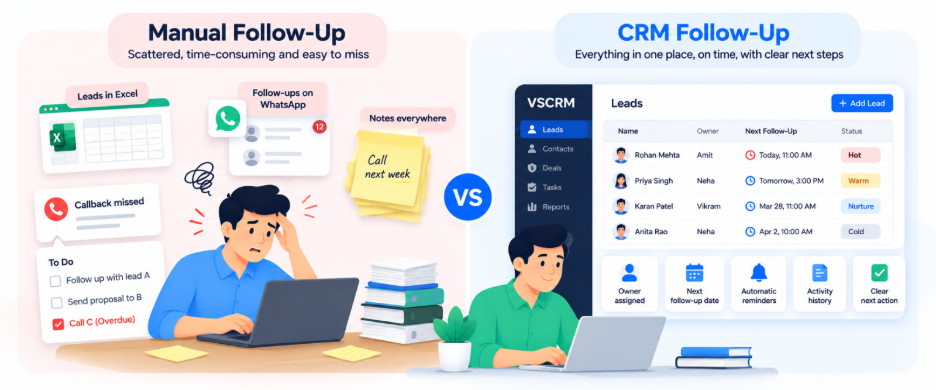
When follow-up depends on spreadsheets, personal reminders and individual WhatsApp chats, the manager usually gets visibility only after asking the salesperson for an update.
A CRM changes that by keeping the follow-up activity attached to the lead itself.
With VSCRM, teams can manage lead ownership, scheduled follow-ups, pending activities and sales stages within the same workflow.
That makes it easier for a salesperson to see what needs attention today and for managers to identify leads that have not been contacted or have overdue follow-ups.
If your sales operation is growing beyond spreadsheets and manual reminders, CRM software becomes useful mainly because it gives the team a shared follow-up system rather than another place to store contact details.
The technology still depends on the quality of the sales process.
If every lead is marked “Follow-up”, the next action is unclear, and salespeople do not record outcomes, automation will not solve much.
The system works best when the team has clearly defined stages, follow-up rules and ownership.
Final Takeaway
A strong sales follow-up process is not about contacting a lead as many times as possible.
It is about keeping the conversation relevant until one of three things becomes clear: the prospect is ready to move forward, the timing is not right, or the opportunity is no longer active.
The seven-touch framework helps sales teams avoid two common problems: giving up after one or two attempts, and repeatedly messaging prospects without adding anything useful.
The most effective follow-ups usually have context from the previous conversation, a clear reason for reaching out and a defined next step.
As lead volume grows, the challenge becomes less about knowing what a good follow-up looks like and more about making sure the team actually does it consistently.
That is where CRM reminders, ownership, activity history and follow-up automation become useful.
If your team is currently managing callbacks across spreadsheets, WhatsApp, calls and personal reminders, you can explore how VSCRM handles lead management and follow-ups or book a demo to see how the process can fit your existing sales workflow.
Frequently Asked Questions
What is a sales follow-up strategy?
A sales follow-up strategy is a planned approach for continuing communication with prospects after the first interaction. It defines what to follow up on, when to reconnect and what should move the opportunity to the next stage.
How many times should you follow up with a sales lead?
There is no fixed number that works for every lead. Seven touchpoints can be a useful framework, but the actual number and timing should depend on the prospect’s level of interest, buying timeline and previous conversations.
What should I say when following up with a lead?
Refer to the previous conversation, address a specific requirement or objection, share something relevant, or propose a clear next action. Repeatedly asking “Any update?” gives the prospect very little reason to respond.
How long should I wait between sales follow-ups?
Follow the prospect’s stated timeline whenever they provide one. If there is no specific commitment, start with shorter gaps and increase the spacing as the sequence progresses.
When should I stop following up with a lead?
Move a lead out of active follow-up when several relevant attempts receive no response, the requirement has been postponed, the prospect has chosen another solution, or there is no current buying intent. Leads that may become relevant later can be moved into nurturing instead.
Can CRM automate sales follow-ups?
Yes. CRM software can schedule follow-up tasks, send reminders, flag overdue activity, maintain lead history and trigger selected communications based on lead stage or activity. Automation works best when it supports the salesperson’s conversation rather than trying to replace it.